
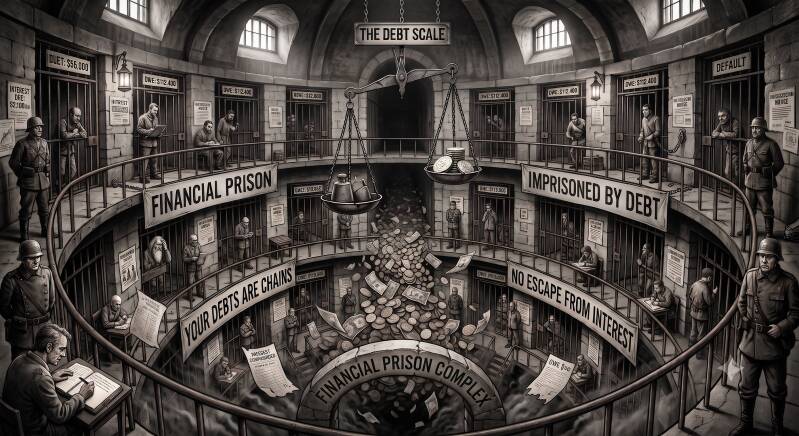
Understanding the Financial Prison Complex

Debt and financial distress are rarely personal moral failures.
The modern consumer credit system is designed as an apparatus
to extract wealth and keep young adults in perpetual financial dependency. Explore the questions below to diagnose the mechanisms at play and learn how to break out toward true financial freedom.
Frequently Asked Questions

Discover the systemic traps holding young climbers back, spot the recurring money habits that slow your progress, and get the practical tools needed to reach the summit.

What is the financial prison complex?

It is a systemic framework explaining why many individuals—especially young adults and college students—find themselves trapped despite working hard and following conventional advice. Rather than viewing debt merely as poor budgeting, this model exposes the modern financial ecosystem as an intentional apparatus designed to extract wealth and maintain a cycle of perpetual debt.

Why do modern credit systems profit off dependency?

Consumer credit structures generate peak profitability when consumers carry revolving high-interest balances month after month. Prompt payoffs eliminate fee and interest revenues, which incentivizes lenders to keep young earners relying on credit cards for emergencies rather than building independent cash reserves.

What is lifestyle creep and why is it dangerous?

Known as the oxygen bleed, lifestyle creep happens when your baseline spending expands automatically alongside promotions, bonuses, or side income. When expenses rise at the same rate as earnings, you remain vulnerable to debt regardless of your salary level.

How does credit card relapse set climbers back?

Also referred to as misusing the safety line, this occurs when an individual builds a solid credit score and mistakes available credit limits for real elevation. Relying on debt limits instead of cash creates a false sense of security that quickly plunges you back into interest traps.

What is the four-step breakout strategy?

The breakout path involves: 1) Diagnostic awareness to recognize consumer traps; 2) Base camp setup to secure a mini-bivvy emergency fund ($1,000–$1,500); 3) Cash calibration through zero-based routing to allocate incoming income deliberately; and 4) Targeted debt elimination to regain cash flow.

What is elevation fear and vertigo?

This is the paralysis of keeping substantial emergency reserves in a standard checking or low-yield savings account earning pennies. Leaving productive cash idle allows inflation to erode purchasing power instead of deploying it into high-yield accounts.

Why is over-leveraging a risky shortcut?

Frustrated by the steady pace of disciplined compounding, ascending climbers often chase speculative shortcuts or excess leverage to reach the peak overnight. This introduces high risk and often triggers severe setbacks back to base camp.

Where should I store my emergency reserves right now?

Deposit your emergency reserves and short-term savings into a dedicated high-yield savings account (HYSA). An HYSA shields your cash from everyday card spending, preserves liquidity for unexpected surprises, and earns significant compound interest.

Ready to break out and secure your ascent?

Stop letting systemic credit traps control your future. Build your base camp, open a high-yield savings account, and begin calibrating your cash today.